

Jun 17,2026
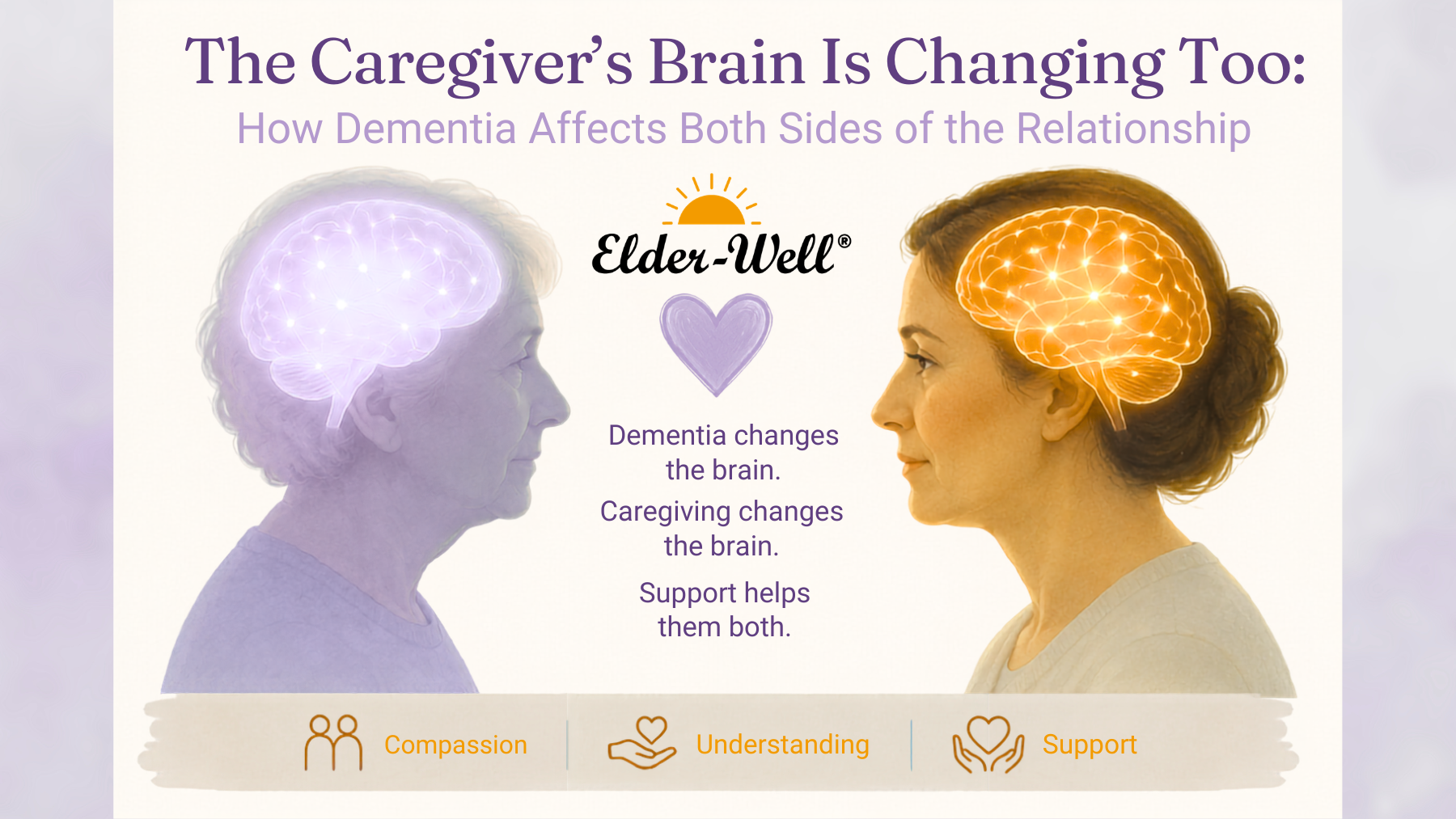
Dementia Is Changing More Than One Brain
When a person develops dementia, we often focus on the changes happening within their brain.
We talk about memory loss, difficulty finding words, changes in judgment, reasoning, behavior, and personality. We recognize that dementia is a progressive brain disease that gradually affects how a person thinks, communicates, and interacts with the world around them.
But there is another brain being affected by the journey as well.
The Caregiver’s.
While the person living with dementia experiences neurological changes caused by disease, caregivers often experience their own changes as a result of chronic stress, emotional strain, disrupted routines, and years of adapting to the evolving needs of someone they love.
In many ways, dementia becomes a two-brain journey.
Dementia is not a normal part of aging. It is caused by diseases that damage brain cells and interfere with communication between different areas of the brain.
In Alzheimer’s disease, the most common form of dementia, abnormal proteins accumulate in the brain, leading to the death of brain cells and gradual brain shrinkage. As the disease progresses, individuals may experience difficulties with memory, language, problem-solving, judgment, emotional regulation, and daily functioning.
These changes are occurring within the brain itself.
The person living with dementia is not choosing to forget. They are not intentionally repeating questions or becoming confused. Their brain is processing information differently than it once did.
Understanding this reality is one of the most important steps caregivers can take toward developing empathy and realistic expectations.
Reference:
https://www.alz.org/alzheimers-dementia/what-is-dementia
While dementia changes the brain of the person receiving care, caregiving can also influence the brain and body of the caregiver.
Research has shown that chronic caregiving stress can affect memory, attention, decision-making, emotional regulation, and overall cognitive functioning. Long-term stress exposure has been associated with changes in areas of the brain involved in learning, memory, and executive function, including the hippocampus and prefrontal cortex.
Caregivers often describe experiences such as:
These experiences are not signs of weakness.
They are often signs of a brain and body operating under prolonged stress.
Reference:
https://pmc.ncbi.nlm.nih.gov/articles/PMC3340013/
The human brain is designed to respond to short-term challenges.
It is not designed to remain in a constant state of vigilance for months or years.
Many dementia caregivers live in a near-continuous cycle of monitoring safety, managing medications, addressing behavioral changes, coordinating appointments, navigating uncertainty, and coping with grief while still providing daily support.
Over time, this persistent stress can elevate cortisol and other stress hormones, which may affect mood, memory, sleep, and overall health.
Research has linked dementia caregiving to increased rates of:
In fact, the CDC reports that approximately one in eight unpaid caregivers age 45 and older experiences worsening confusion or memory loss, a rate higher than that reported by non-caregivers.
Reference:
https://www.cdc.gov/caregiving/data-research/memory-loss/index.html
Beyond the physical effects of stress, caregiving changes the emotional landscape of the brain.
Many caregivers experience:
The relationship itself often changes over time.
A spouse may become a care partner.
A daughter may become a decision-maker.
A son may become responsible for managing medications, transportation, finances, and safety concerns.
These role changes require the brain to continually adapt to new responsibilities and emotional demands.
At the same time, caregivers are often grieving the gradual loss of the person they once knew, even while that person is still physically present.
One of the most overlooked aspects of caregiving is the amount of mental flexibility it requires.
Caregivers constantly adjust:
The brain is continuously learning, adapting, planning, and problem-solving.
While this demonstrates remarkable resilience, it can also be exhausting.
Many caregivers describe feeling as though they are “always on.”
That feeling is often real.
Their brains are working overtime.
The good news is that caregivers are not powerless.
Research consistently shows that social support, education, respite opportunities, physical activity, stress management, meaningful engagement, and adequate sleep can help reduce caregiver burden and improve overall well-being.
Caregivers often hear:
“You have to take care of yourself.”
A better message may be:
Protect your brain the same way you are working to support theirs.
Reference:
https://www.alz.org/help-support/caregiving/caregiver-health
One reason adult day programs can be so valuable is that they support both sides of the dementia journey.
While participants benefit from:
Caregivers gain something equally important:
Time.
Time to work, attend appointments, recharge, exercise, socialize, or simply breathe.
Supporting the caregiver is not separate from supporting the person living with dementia.
The two are deeply connected.
When caregivers are healthier, less stressed, and better supported, everyone benefits.
Dementia changes the brain.
But it does not change only one brain.
The person living with dementia experiences the direct neurological effects of disease. The caregiver experiences the emotional, physical, and cognitive effects of adapting to that disease every day.
Understanding both sides of the relationship helps us approach caregiving with greater compassion.
Because while one brain may be changing because of dementia, another is changing because of love, responsibility, resilience, and the remarkable effort required to walk alongside someone on this journey.
And that caregiver deserves support too.
Resources
Alzheimer’s Association Caregiving Center
https://www.alz.org/help-support/caregiving
CDC Caregiving Resources
https://www.cdc.gov/caregiving
National Institute on Aging Caregiving Resources
https://www.nia.nih.gov/health/alzheimers/caregiving
Feel free to contact us with any questions regarding our services or to schedule a visit.