

May 15,2026
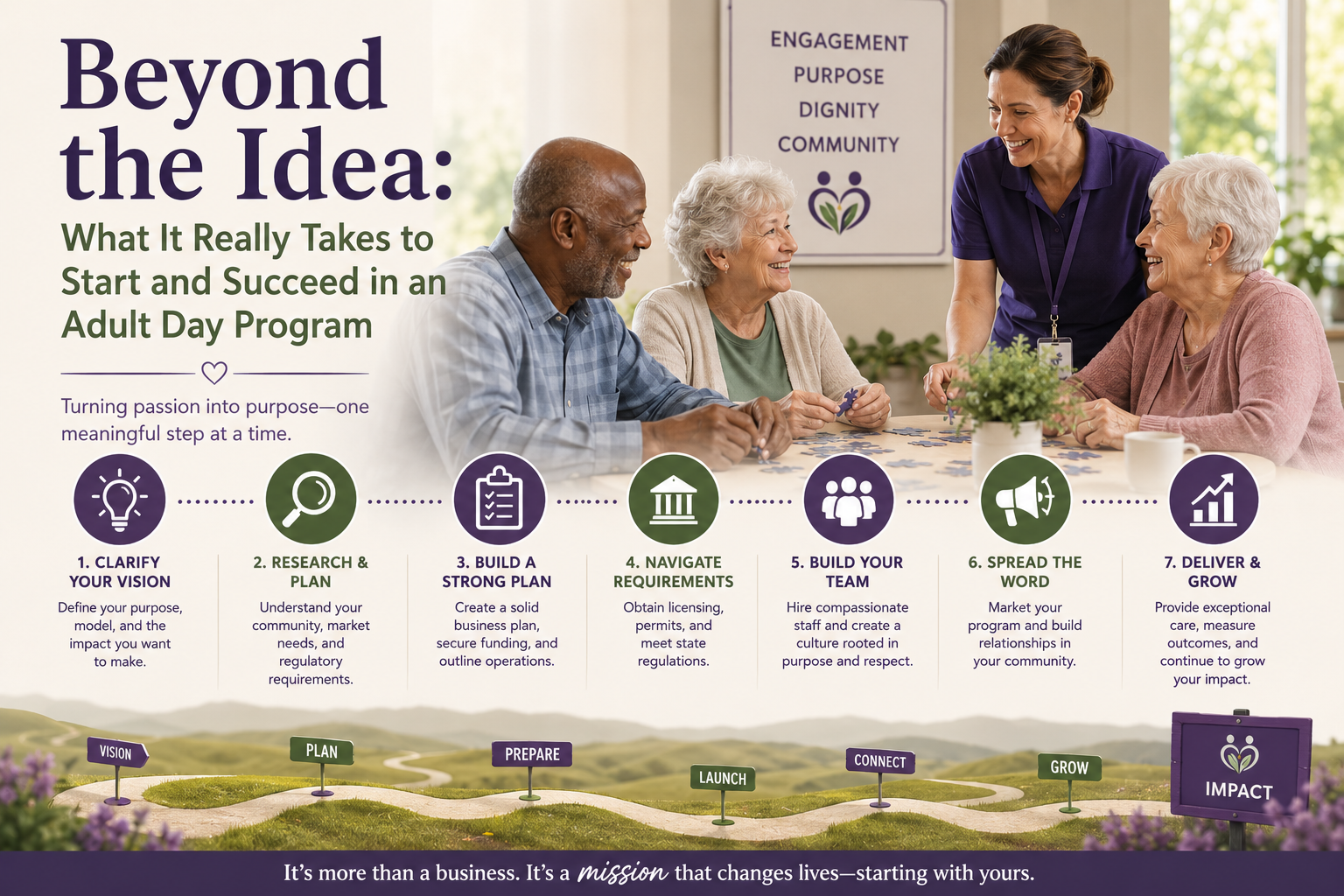
To start and run a successful adult day program, you need a clear model, the right team, and a well-designed experience that supports both seniors and their caregivers.
The idea of opening an adult day program often begins with something simple, a desire to make a difference.
But as many quickly discover, turning that idea into a sustainable, impactful program requires more than good intentions. It takes clarity, planning, and a strong understanding of what truly makes these programs work, not just operationally, but experientially.
As the landscape of aging continues to shift, adult day programs are becoming an essential part of the care continuum. They offer a middle ground between being fully independent at home and transitioning into higher levels of care, providing structure, connection, and support at a critical time for both individuals and families.
If you’re exploring this path, here’s what to consider.
The cost to open an adult day program can vary widely depending on location, size, and overall program model.
Some of the most common startup considerations include:
Beyond the initial investment, there is also the consideration of building sustainable enrollment over time. Unlike some businesses that generate immediate revenue, adult day programs often require a period of growth as awareness builds within the community.
It’s also important to recognize that the environment you create plays a significant role in both experience and success. Families are not just evaluating services, they are evaluating how a space feels, how their loved one is received, and whether they can trust the program with ongoing care.
A thoughtful investment in both environment and experience often makes a meaningful difference.
Success in adult day services is not defined by attendance alone; it’s defined by the experience created each day.
While there is no single formula, the most effective programs tend to share several foundational elements:
It’s easy to assume that a full calendar equals engagement. In reality, meaningful participation comes from how activities are facilitated and how individuals are supported within them.
Engagement should feel approachable, inclusive, and adaptable, not overwhelming or passive.
A well-designed daily flow provides comfort and predictability. For many participants, especially those experiencing cognitive changes, structure helps reduce anxiety and supports confidence. The Alzheimer’s Association notes that structured and pleasant daily activities can reduce agitation and improve mood for people living with dementia.
Consistency is not about rigidity; it’s about creating a rhythm that people can rely on.
Programs that understand their purpose and communicate it clearly build stronger trust within their communities.
Clarity helps families know what to expect and helps staff deliver a more consistent experience.
Referrals rarely happen by chance. They are built through trust, visibility, and consistent presence within the community.
Relationships with families, local professionals, and organizations are often the foundation of long-term growth. The most successful adult day programs are often deeply woven into the fabric of their local communities, becoming known not just for services, but for relationships.
Research increasingly shows that relationship-centered and community-oriented care models create stronger engagement, improved continuity of support, and greater confidence among families seeking services. The National Academies of Sciences, Engineering, and Medicine notes that person-centered and community-oriented care depends heavily on “building and maintaining relationships” among individuals, families, and community partners.
Participants are not simply “attending a program”; they are part of a community. The way they are spoken to, supported, and included shapes their overall experience.
Programs that prioritize dignity, belonging, and meaningful connection often see stronger engagement and retention. The Eden Alternative® and related culture-change research in aging services emphasize that combating loneliness, helplessness, and boredom through meaningful relationships and purposeful engagement can increase participation and overall satisfaction among older adults.
.
Adult day programs play a unique and increasingly important role in today’s care landscape. Adult day programs are uniquely positioned to support both the older adult and the caregiver; something few services in the care continuum are designed to do simultaneously. According to the CDC National Center for Health Statistics, approximately 182,000–197,000 individuals participate in adult day services on any given day in the United States, and demand continues to rise as the population ages.
For many families, there is a gap between the moment they begin noticing changes in a loved one and the point where higher levels of care are required. This in-between space can feel uncertain and overwhelming.
Adult day services help bridge that gap.
They provide:
Rather than replacing other forms of care, adult day programs often work alongside them, extending the ability for individuals to remain at home while still receiving meaningful support.
This positioning is one of the reasons demand continues to grow.
While the opportunity is strong, this type of business is not for everyone and it’s important to approach it with clarity.
It may be a good fit if you:
This work requires both heart and discipline. The most successful operators recognize that both are equally important.
When families begin searching for support, they are often navigating uncertainty, stress, and difficult decisions.
While services and pricing matter, what families are often looking for goes deeper:
Programs that understand these underlying needs are better positioned to connect with families in a meaningful way.
This is often where the difference between a program that simply operates and one that truly grows becomes clear.
For those who feel aligned with this type of work but want guidance along the way, a franchise model can offer a structured path forward.
At Elder-Well® Adult Day Program, the focus is on a social-supportive model that prioritizes engagement, connection, and daily structure.
Rather than approaching care from a purely clinical perspective, the model emphasizes meaningful interaction and thoughtfully guided experiences designed to support both individuals and their families.
For many entrepreneurs, having an established framework, training, and ongoing support can make the process of opening and growing a program more approachable.
Exploring a franchise is not about limiting creativity; it’s about starting with a strong foundation.
If you would like to discuss this opportunity further, please contact us by filling out the form below.
Timelines can vary based on location, licensing, and securing a space. For many, the process can take several months to a year from initial planning to opening.
Not necessarily. Many programs operate under a social or supportive model rather than a clinical one. Having the right team, training, and structure is often more important than having a medical background yourself.
Staffing depends on participant needs, program size, and state regulations. Most programs operate with a team approach to ensure both safety and engagement.
Profitability depends on factors such as location, enrollment, pricing, and operational management. With strong demand and thoughtful planning, adult day programs can become sustainable businesses over time.
Most adult day programs offer:
Services may vary depending on the program’s model and focus.
Opening an adult day program is about more than launching a service; it’s about creating a space where people feel connected, supported, and valued.
As demand continues to grow, so does the opportunity to build programs that meet families where they are, offering support before crisis and connection when it’s needed most.
For those considering this path, the question isn’t just “Can I open a program?” It’s “What kind of experience do I want to create and who do I want to serve?”
Because in this field, the experience you create is what defines your success.
Feel free to contact us with any questions regarding our services or to schedule a visit.